
Spiritual programme
Introductory
To Monday 06 January 2025
Chekawa's Seven-Point Mind Training
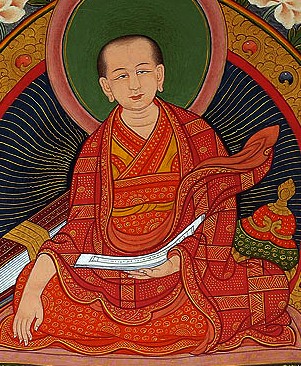
(via Wikimedia Commons)
Mind training is a theme of Mahayana teachings that the very essence of the Dharma path is to transform one's attitude from instinctive self-cherishing to genuinely always putting others first, and that there are no actual obstacles to practice, as every difficulty can be viewed with the right perspective as a blessing and a boost to one's practice. Intellectually these teachings are very easy to understand, but we all know that's not easy to do. Thus, mind training is considered the quintessence of the path to Buddhahood.
Seven-Point Mind Training is one of the most influential works of mind training composed in Tibet. This very succinct text was composed by Chekawa Yeshe Dorje (1101–1175) according to the Kadampa tradition of Atisha Dīpaṃkara. Through such texts, Atisha's teachings suffused throughout all traditions of Tibetan Buddhism to come down to us today.
The seven points cover:
- preliminaries
- main practice
- transformation of adversity
- life-long application of the practice
- measures of progress
- commitments
- precepts.
Format of the course will incorporate:
- Dharma teachings
- review / question and answer sessions, and
- guided meditations.
Texts
With kind permission from Lotsawa House:
Teacher
Serkong Rinpoche's past incarnation had a strong connection with Kyabje Lama Zopa Rinpoche and early FPMT students, which is continuing in this incarnation. We feel very honoured to again offer an occasion for students to meet and make a connection with Serkong Rinpoche.
Find out more about Serkong Rinpoche on our visiting teachers page.
Relevant quotations
Beings are like reflections of the moon in rippling water;
seeing them as fleeting and as devoid of intrinsic nature,
the bodhisattva’s mind falls under compassion’s sway,
yearning to set free every transmigrating being.Candrakīrti’s Entering the Middle Way, Chapter 1 Verse 4
If, when free and living with favorable conditions,
we do not retain this status we enjoy,
we will fall into the abyss and be at the mercy of others.
What could enable us to rise up again from such a state?Candrakīrti’s Entering the Middle Way, Chapter 2 Verse 5
Seeing with their wisdom that all afflictions and all faults
stem from the identity view grasping at the perishable collection,
and knowing that self is the focus of this identity view,
the yogi engages in the negation of selfhood.Candrakīrti’s Entering the Middle Way, Chapter 6 Verse 120
Whenever someone out of envy
Does me wrong by attacking or belittling me,
I will take defeat upon myself,
And give the victory to others.Geshe Langri Thangpa's Eight Verses of Training the Mind, Stanza 5
The Great Ones do not wash away sin with water;
They do not rid beings of suffering with their hands;
They do not transfer realizations of suchness onto others.
They liberate by teaching the truth of suchness.From the sutras
When karma and mental afflictions are exhausted, there is liberation.
Karma and mental afflictions come from conceptual thoughts.
These come from mental elaborations.
Mental elaborations are ceased by emptiness.OR:
When karma and mental afflictions are exhausted, there is liberation.
Karma and mental afflictions come from conceptual thoughts.
These come from mental elaborations,
And mental elaborations are ceased in emptiness.Nagarjuna’s Fundamental Wisdom, Chapter 18 Verse 5
To him who in compassionate wisdom,
Taught the sacred Dharma
For the relinquishing of all views
To him, Gautama, I bow down.Nagarjuna’s Fundamental Wisdom, concluding homage.
Schedule
| Fri 3 Jan | |
| 4:30 pm | Course registration – in office |
| 6:00 pm | Dinner |
| 7:00 pm | Introduction to course by Spiritual Programme Coordinator(SPC) |
| Sat 4 | Mon 6 Jan |
| 6:45 am | Morning meditation |
| 7:30 am | Breakfast |
| 9:00 am | Teachings with Serkong Tsenshab Rinpoche |
| 11:00 am | Tea break |
| Noon | Lunch |
| 2:00 pm | Discussion groups |
| 3:00 pm | Tea break |
| 3:30 pm | Teachings with Serkong Tsenshab Rinpoche |
| 6:00 pm | Dinner |
| 7:00 pm | Q&A with a senior student, and with Rinpoche on the 5th |